Car Export Workflow Automation: 15 Bottlenecks Japanese Exporters Should Fix First
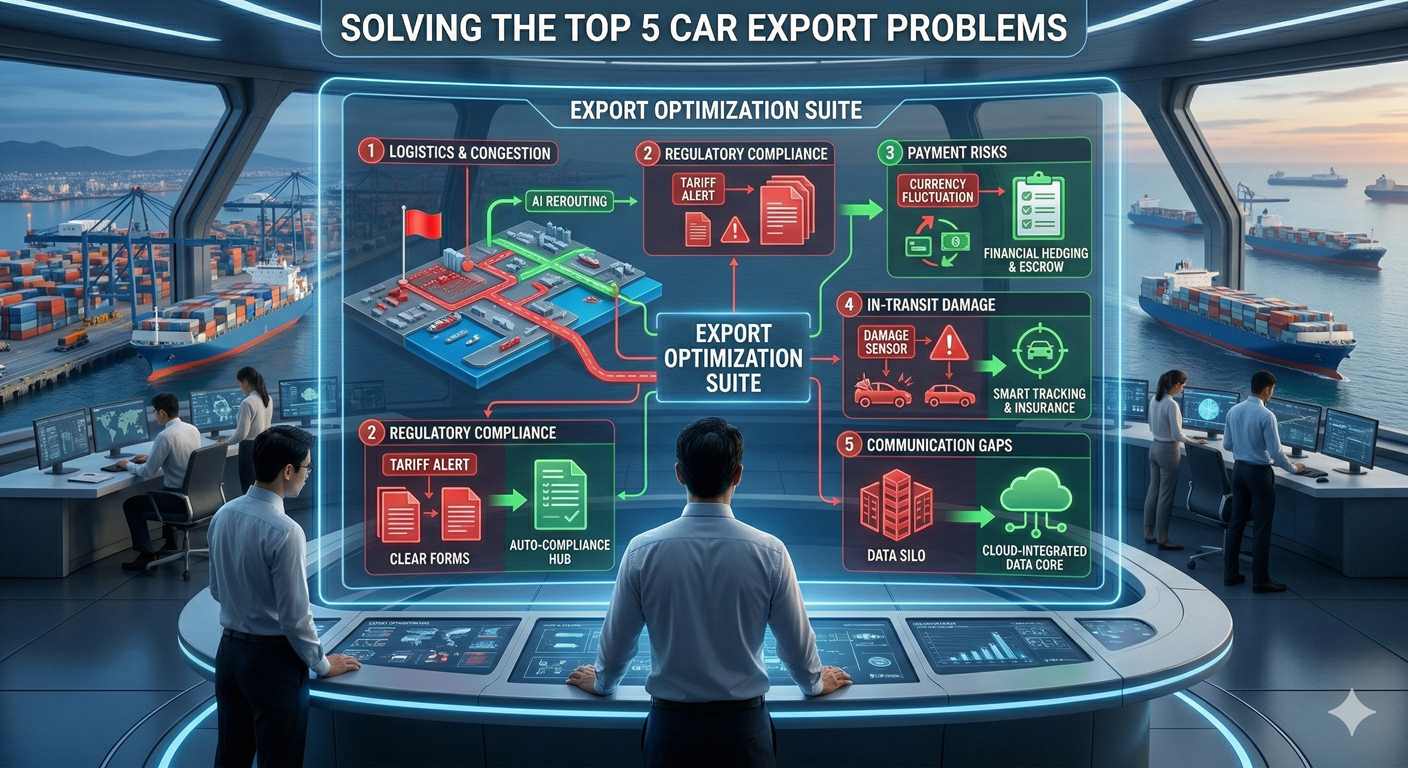
Most exporters do not decide to improve workflow because they suddenly love software. They decide because daily work starts to feel heavier than it should. Staff repeat the same status conversations, buyers ask for updates that should already be visible, documents hold up shipments longer than expected, yard teams answer location questions manually, and management cannot see the real bottleneck until the damage is already commercial. These are not random problems. They are signals that the workflow is no longer structured enough for the business you are trying to run.
That is why car export workflow automation should begin with bottlenecks, not with feature shopping. When you identify the stages that repeatedly create delay, confusion, or customer friction, it becomes much easier to choose the right automation priorities. The goal is not to automate everything at once. The goal is to remove the bottlenecks that disrupt the most downstream work and consume the most management attention.
This guide maps 15 of the most common exporter bottlenecks and explains what workflow automation should do about each one. It is written for Japanese used car exporters, auction buyers, operations managers, yard supervisors, and logistics teams. If you want the broader checklist first, start with the car automation software checklist. If you want a stage-by-stage process view, read auction-to-shipment automation next.
A useful rule
The best bottlenecks to automate first are the ones that happen frequently, create downstream rework, and weaken customer confidence at the same time.
Why bottleneck-driven automation works better than feature-driven automation
Export teams often buy software by comparing feature lists: inventory, documents, reports, shipping, CRM, permissions. Those categories matter, but they do not tell you where the workflow is actually failing. Bottleneck-driven automation starts from the opposite direction. It asks which tasks repeatedly slow down the business, where information breaks between departments, and which questions management has to ask over and over again. Once you know those answers, the necessary feature priorities become much clearer.
This method is also better for adoption. Staff will use a system more consistently when it solves a visible pain point quickly. If the platform reduces repeated follow-up on blocked documents, fixes uncertainty around yard readiness, or makes buyer updates more consistent, the team feels the improvement almost immediately. That creates momentum. In contrast, a system can include many advanced features and still fail if it does not address the workflow pressure everyone experiences every day.
In practical terms, exporters should think of automation as a sequence of workload reductions. Each improvement should remove one source of avoidable friction, then make the next improvement easier to implement.
The 15 bottlenecks to fix first
1. Purchase details are captured late or inconsistently
When purchase information enters the system late, every later stage starts with weak context. Workflow automation should turn the winning bid or purchase decision into a live record immediately, with source, costs, buyer context, and route assumptions attached from the start.
2. Maximum bid logic lives in private spreadsheets
If bid ceilings are calculated outside the operational workflow, margin discipline becomes personal instead of structural. Automation should connect purchase decisions to a visible landed-cost and pricing model so the commercial logic survives beyond the buyer's notebook.
3. The same vehicle is re-entered by multiple teams
Duplicate entry is one of the clearest signals that workflow is broken. A purchased unit should not become “new information” at the inventory stage. The platform should carry the same record forward into operations and yard work.
4. Yard location is known physically but not digitally
Many exporters can find a vehicle on the ground faster than in the system. That is a control problem. Automation should make gate-in, location, movement, and hold status visible enough that management and logistics can trust the live record.
5. Preparation status is vague
“Not ready yet” is not an operational status. Exporters need structured readiness stages so teams know whether the unit is waiting for inspection, repair, cleaning, paperwork, release, or booking. Vague status language creates repeated follow-up and bad planning.
6. Photos and condition evidence are detached from the workflow
If photos, inspection notes, and yard observations sit outside the live record, teams lose time proving what happened. Automation should attach evidence directly to the vehicle and make it visible at the stages where it affects pricing, buyer updates, or preparation decisions.
7. Documents are stored, but readiness is not managed
File storage alone does not prevent export delay. Workflow automation should show which documents are required, which are complete, which are blocked, and whether booking should proceed. That is one reason exporters should treat document control as workflow control.
8. Booking readiness is decided by informal checking
When logistics has to ask multiple people whether a unit is really ready, the workflow is too dependent on memory. A system should make booking candidates and blockers visible automatically from status and document conditions.
9. Buyer updates depend on manual reminders
Buyers should not receive milestones only when someone remembers. Automation should standardize communication triggers for key events such as purchase confirmation, yard intake, booking, departure, and final release.
10. Payment milestones are not tied to operational flow
Commercial checkpoints and operational checkpoints need to speak to each other. If payment or approval context is detached from shipment progress, teams can move work forward without realizing commercial prerequisites are still open.
11. Staff can change critical data without clear permission boundaries
As teams grow, uncontrolled editing creates hidden risk. Automation should include role-based permissions and an action trail so the system improves accountability instead of centralizing confusion.
12. Exceptions stay private for too long
A blocked document, delayed transport, or missing yard confirmation should not remain inside one person's awareness. Workflow automation should expose exception age, owner, and escalation path before the issue becomes commercial damage.
13. Management cannot see which stage creates the most delay
If reporting only happens at month-end, recurring workflow weakness lasts longer than necessary. Exporters need weekly visibility into blocked units, stock age, shipment lag, and buyer-update delays so the pattern becomes visible early.
14. New staff need tribal knowledge to operate safely
When onboarding depends on verbal explanation and old spreadsheets, the process is too informal to scale. Automation should make the workflow visible enough that staff learn the system and the process together.
15. Different departments maintain different versions of truth
This is the bottleneck behind many other bottlenecks. If buying, yard, documents, logistics, and buyer teams maintain separate records, small mismatches compound into larger delay. The real automation goal is one operational truth that every department can trust.
How to prioritize bottlenecks without overcomplicating the rollout
A practical prioritization model uses four questions. First, how often does the bottleneck happen? Second, how much money or time does it cost when it happens? Third, how much customer trust does it affect? Fourth, how many downstream stages depend on it? A bottleneck that happens daily, damages buyer confidence, and blocks multiple teams should rank above a niche issue that only appears occasionally.
This method helps exporters avoid a common mistake: automating the most visible process rather than the most disruptive one. For example, a flashy buyer notification tool may look attractive, but if document readiness is still unclear, the notification layer will only distribute confusion faster. The better sequence is usually to stabilize internal truth first, then automate customer-facing communication around that truth.
This is also why exporters often start with visibility bottlenecks before approval bottlenecks. Once the team can trust status, approvals become easier to implement because the underlying workflow is already cleaner.
A simple scorecard exporters can use this month
If you want to make the prioritization more objective, score each bottleneck from 1 to 5 across four dimensions: frequency, commercial cost, buyer impact, and downstream disruption. Frequency means how often the issue appears. Commercial cost means how much time, margin, or avoidable overtime it creates. Buyer impact means whether the issue affects customer trust or speed of response. Downstream disruption means how many later stages are slowed by the problem. The highest combined scores usually represent the first automation opportunities.
For example, weak purchase capture may score high on frequency and downstream disruption because it affects inventory, documents, and logistics. Poor buyer notification may score high on customer impact, but lower on internal disruption if the underlying status is already clean. This kind of scoring helps managers stop debating based on personal frustration alone. It turns the conversation into workflow economics.
You do not need a complicated consulting exercise to use this method. A simple review with owners from buying, operations, yard, logistics, and finance is usually enough to reveal which two or three issues deserve the first automation effort.
What governance should look like once automation starts working
Workflow automation is not only about faster execution. It should also create better governance. That means defining which team owns each status, which stage requires managerial review, which exceptions escalate automatically, and which roles can change critical fields. Governance is especially important for exporters that already operate across multiple users, branches, or destination markets because process inconsistency grows faster than shipment volume.
A mature setup normally gives admin or leadership roles clearer permission control, operations teams stronger responsibility for live status, yard teams structured readiness ownership, and logistics teams reliable booking signals. Reporting then serves as the management layer above those roles rather than as a substitute for them. If you are choosing software at the platform level, this is where a true car export management software platform separates itself from lighter point solutions.
Good governance does not slow the business. It removes the need for management to intervene manually in tasks that should already be structured.
What teams should not automate first
Just as some bottlenecks deserve priority, some automation ideas should wait. Exporters often jump too quickly into complex approval chains, niche route customizations, or highly polished client-facing automation while the internal source of truth is still weak. That sequence feels attractive because the output looks advanced, but it tends to preserve the real bottlenecks underneath. If inventory status, documents, and booking readiness are still unclear, advanced add-ons usually become another layer of noise rather than a real fix.
It is usually smarter to postpone anything that depends on highly reliable data until that data is actually reliable. In practice, that means stabilizing purchase capture, live vehicle status, document checkpoints, and exception visibility before building more elaborate workflow branches. This disciplined order is one reason the most effective automation rollouts feel operational first and technical second.
The principle is simple: automate the process that prevents downstream confusion before you automate the process that merely looks more sophisticated.
Why bottleneck removal changes margin and buyer trust together
Exporters sometimes treat internal workflow and customer trust as separate topics. In reality, they are tightly connected. A unit delayed by poor yard visibility can become a buyer communication issue. Weak document readiness can become a shipping issue and then a margin issue. Repeated manual follow-up can become an overtime issue and then a management-quality issue. The same bottleneck can therefore damage profit, speed, and trust at the same time.
That is why automation decisions should be evaluated across both internal efficiency and customer outcome. If a workflow improvement reduces exception age, makes buyer updates more reliable, and helps management react earlier, it is usually worth more than a narrower tool that only improves admin comfort. This is the deeper business case for workflow automation: not only cheaper operations, but more predictable commercial performance.
Exporters who understand this tend to choose automation priorities more effectively because they stop seeing process cleanup as back-office work alone. They see it as part of competitive execution.
How one shared record changes day-to-day management
When exporters remove bottlenecks successfully, the biggest practical shift is often the emergence of one shared operational record. That record changes daily management in several ways. First, discussions become shorter because teams no longer spend the opening minutes trying to confirm basic facts. Second, management reviews become more useful because the conversation can focus on exceptions rather than reconstruction. Third, accountability improves because each stage has visible ownership instead of ambiguous responsibility spread across chat messages and spreadsheets.
This kind of shared record is particularly important in export businesses because several departments touch the same unit for different reasons. Buying sees cost and source context. Yard sees location and readiness. Documents sees compliance and release. Logistics sees booking and route timing. Buyer management sees communication and expectation control. If each team keeps only its own truth, leadership ends up coordinating manually between partial realities. Workflow automation becomes powerful when it removes that managerial translation work.
That is also why exporters should evaluate automation tools by asking whether the platform creates one trustworthy operational history for each vehicle. If it does not, the business may digitize more tasks but still struggle with the same bottlenecks underneath.
Questions to ask before automating any bottleneck
Before you automate a bottleneck, ask what information is missing, who needs to act on it, and what downstream stage depends on that action. If you cannot answer those three questions clearly, the workflow is probably not ready for automation yet. The first task may be to define the stage, owner, and required fields more precisely. Automation works best when it formalizes a process that the business understands, not when it tries to hide a process the business has never clarified.
You should also ask whether the bottleneck is caused by a rule problem or only by a visibility problem. Some issues require better status structure. Others require approval control. Others require faster escalation. Treating every problem as the same kind of automation opportunity leads to bloated solutions. A disciplined exporter identifies the real mechanism behind the delay, then applies the lightest workflow design that actually fixes it.
These questions keep the rollout grounded. They help the team automate with intent instead of turning every operational frustration into a feature request.
A 90-day sequence exporters can actually implement
In the first 30 days, exporters should fix purchase capture, live vehicle status, and the minimum document-readiness model. These three layers answer the most repeated internal questions and create a workable system of record. In days 30 through 60, the focus should shift to stockyard readiness, booking candidates, and exception visibility. This is the point where logistics and buyer communication start to feel more stable because internal readiness becomes more trustworthy.
Between days 60 and 90, the team can strengthen approvals, permissions, and management reporting. At this stage, the goal is not only operational clarity but better control over scale. Once the business sees which stages generate recurring friction, it can refine forms, alerts, dashboards, and customer communication templates with much better accuracy than at the beginning.
That sequence may feel slower than an all-at-once rollout, but it usually produces stronger adoption because each improvement is tied to a visible bottleneck the team already understands.
External references exporters should keep in view
Exporter bottlenecks are internal, but they still sit inside a wider trade environment. Teams should therefore stay aware of external references such as JETRO, Japan Customs, and the World Customs Organization. Those sources do not replace your internal workflow design, but they help exporters stay connected to the trade, customs, and compliance context that shapes the pressure around those bottlenecks.
The strongest export operations usually combine tight internal workflow with steady awareness of the external environment that can affect shipment timing and document expectations.
Suggested image alt text for this article
- • Car export workflow automation bottlenecks for Japanese used car exporters
- • Export operations bottleneck map across auction, inventory, documents, shipping, and buyer updates
- • Workflow automation priorities for Japan car export operations teams
Related guides for workflow improvement
Car automation software checklist
Use the checklist to choose the first automation priorities after identifying the bottlenecks.
Auction-to-shipment automation
See how the bottlenecks fit inside the full exporter flow from purchase to booking.
Stockyard management for car exporters
Dig deeper into one of the workflow layers that most often blocks booking readiness.
Car export buyer management
See how better workflow control improves communication and buyer trust at the same time.
Related Solutions
Explore the solution pages behind this workflow model
Car export automation software
See how SmartApp structures exporter workflow automation across buying, inventory, and logistics.
Car export management software
Review the broader operating system behind the workflow improvements described here.
Car export software features
Compare the modules for inventory, orders, permissions, and reporting that support cleaner execution.
Frequently asked questions
What is the first bottleneck most exporters should automate?
How do exporters choose which bottleneck to fix first?
Can workflow automation help without a full system replacement?
Need a workflow that removes the right bottlenecks first?
The strongest exporter software does not only centralize data. It reduces the operational friction that slows teams, frustrates buyers, and hides risk from management.
If that is the outcome you want, review the SmartApp workflow model with your real bottlenecks in mind.
Book a Free Demo