Table of Contents
Why pricing is a control problem, not just a math problem
Japanese used car pricing for export is often discussed as if it were a simple markup exercise. It is not. The number an exporter can quote with confidence depends on a chain of operational decisions that starts before auction and does not end until the vehicle is shipped, documented, and fully costed. When that chain is weak, pricing becomes reactive. Teams win stock they cannot profitably move, sales staff quote against outdated freight assumptions, and managers discover the real margin too late to correct it.
That is why serious exporters treat pricing as a control system. The question is not only what a vehicle is worth. The question is whether the company can source it, prepare it, document it, ship it, and collect payment without hidden cost eroding the deal. Two exporters can buy the same model at the same auction, yet one still loses margin because its downstream process is slower, less visible, or less disciplined.
This guide is written for Japanese used car exporters, auction buyers, stockyard managers, and export operations teams that need a workable pricing framework. The goal is to make bid ceilings tighter, quotes cleaner, and margin more predictable. If you are already working through the broader operating model in our car export business cost guide, think of this article as the per-unit pricing layer that sits on top of that cost discipline.
In short
The strongest exporters price backward from the market, not forward from the auction result. They set the likely selling price first, subtract every known downstream cost, protect a target margin, add a reserve for volatility, and only then approve the bid ceiling.
The export cost stack behind every quote
A surprising number of pricing mistakes happen because exporters carry an incomplete cost stack. Purchase price is visible, so everyone remembers it. Auction-side charges, inland transport, small repair work, storage, document preparation, freight variation, insurance, banking cost, and exception handling are less visible, so teams underweight them. Thin-margin businesses do not usually collapse because of one big error. They weaken because small omissions repeat across dozens of units.
To price Japanese used cars for export properly, you need a consistent view of where cost enters the workflow and when it becomes locked. That timing matters. Some costs are known before you bid. Others are only estimates until yard inspection or vessel booking. A professional pricing process tracks both the amount and the confidence level of each line item.
| Cost layer | Typical items | When it becomes clear | Pricing risk if ignored |
|---|---|---|---|
| Vehicle acquisition | Hammer price, recycling fee treatment, auction-side taxes or charges | Before and at auction | Overbidding destroys margin immediately |
| Auction processing | Auction fee, agent fee, lot handling | Known before bidding if your fee schedule is clean | Teams treat fees as small and then lose consistency |
| Domestic logistics | Transport to yard, local move, storage, handling | Estimated pre-bid, confirmed after movement | Distance and timing assumptions are often wrong |
| Vehicle preparation | Cleaning, battery, tire work, minor repair, photo prep | Confirmed after yard inspection | Condition surprises can erase a thin gross margin |
| Export administration | Invoice handling, export certificate, compliance documents, port paperwork | Mostly predictable if the workflow is standardized | Document corrections delay shipment and extend cash lockup |
| Ocean freight and insurance | RoRo or container cost, surcharges, marine insurance | Depends on route and booking window | Old freight assumptions create underquoted deals |
| Payment and FX | Bank transfer charges, currency conversion, rate drift | Known by policy but volatile in outcome | A weak FX rule silently narrows realized margin |
| Aging and exception cost | Stock aging, rework, delayed booking, discount pressure | Visible only if you track units over time | The deal looked profitable on day one but not by shipment day |
The quote basis matters as well. A unit priced on an FOB basis should not carry the same downstream assumptions as a C&F or CIF quote. If the buyer controls freight, your cost stack ends earlier. If you are quoting a fuller shipping offer, your freight visibility and validity window become part of the pricing discipline itself.
How to build a bid ceiling before auction day
The fastest pricing improvement most exporters can make is simple: stop deciding the maximum bid while the auction is already moving. A bid ceiling should be approved before the lot goes live. Otherwise the buying team starts negotiating emotionally with the screen instead of commercially with the market.
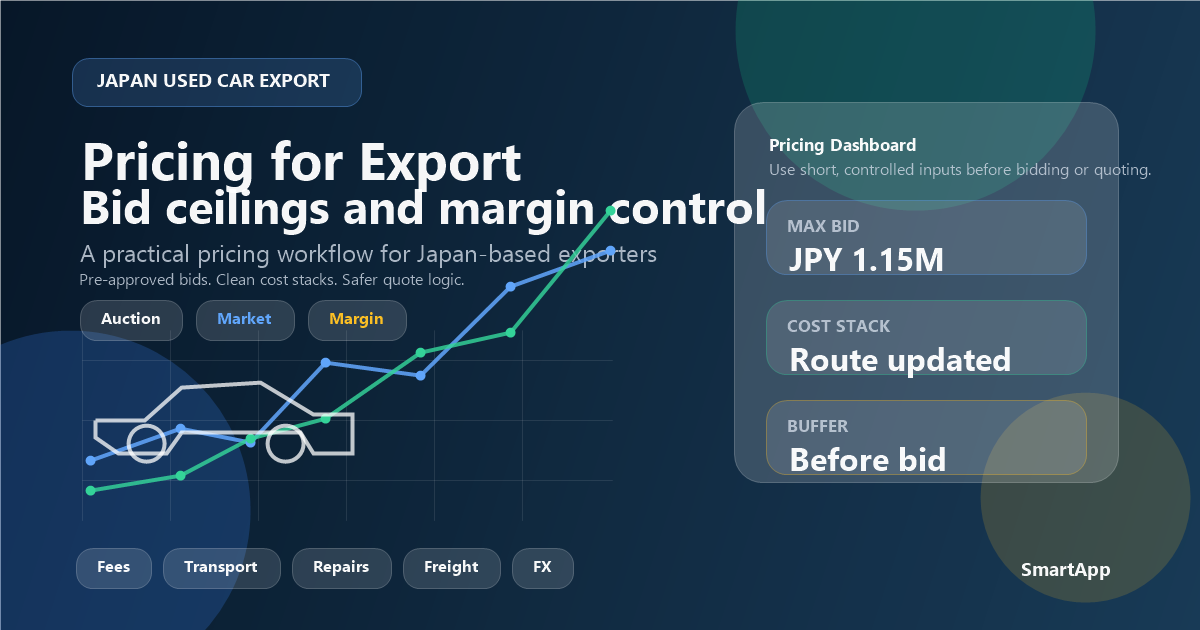
A practical ceiling starts with the realistic selling price for the buyer and route you care about. That is a market number, not an aspiration number. Then you subtract every cost required to turn the lot into a shipped unit. After that, you subtract the gross margin your business requires and a reserve for volatility. The remainder is the maximum acquisition cost you can tolerate.
Bid Ceiling Formula
Maximum hammer price = realistic selling price - downstream cost - required gross margin - volatility reserve
If you are quoting C&F or CIF, treat freight and insurance as downstream cost. If you are pricing FOB, do not pretend freight risk disappeared. It still matters if the buyer is comparing your offer against all-in competitor quotes.
| Worked example: compact wagon for dealer buyer | JPY | Pricing note |
|---|---|---|
| Target FOB selling price | 1,520,000 | Based on current dealer demand, spec, and condition expectations |
| Auction fee and handling | 72,000 | Known fee schedule, not a guess |
| Transport to yard | 38,000 | Route-based estimate from the auction house |
| Cleaning and minor repair reserve | 55,000 | Applied because grade alone does not confirm retail readiness |
| Documents and admin | 20,000 | Should be stable if the process is standardized |
| Required gross margin | 140,000 | Adjusted by buyer type and support burden |
| FX and exception reserve | 45,000 | Protects against rate movement or small condition surprises |
| Maximum hammer price | 1,150,000 | If bidding goes above this, the deal needs a new commercial reason |
The point is not that every exporter should use these exact numbers. The point is that a ceiling must exist before bidding starts. If you need cleaner lot-level discipline, this is where tighter car auction management software for exporters becomes commercially useful instead of feeling like a reporting layer added later. If your team still approves bids ad hoc, compare that approach against the structured buying workflow in our Japanese car auctions guide.
Valuation drivers that change export price faster than most teams expect
A lot can look commercially attractive on paper and still be priced badly for export. The difference usually sits in valuation inputs that are easy to miss when the team is moving too quickly. These drivers should feed directly into the pricing worksheet, not remain trapped in the buyer's head.
1. Auction grade is a starting signal, not a finished valuation
Exporters often lean too heavily on grade, mileage, and the broad auction notes. Those indicators matter, but they are not the whole commercial picture. Two grade-4 units can carry very different post-purchase realities once the car reaches the yard. Tire condition, missing accessories, battery state, small panel repair, underbody corrosion, or poor interior odor can all shift the cost required to make the unit buyer-ready.
The practical rule is to price for the likely yard reality, not only for the auction summary. Conservative exporters keep a repair reserve by vehicle segment or source type because they know inspection clarity improves only after transport. That reserve protects pricing discipline without forcing every lot into an overcomplicated approval process.
2. Market fit matters more than broad popularity
The same model can support very different export prices depending on market fit. Transmission type, fuel type, seating configuration, grade level, color, age, and buyer expectations all change how easy the unit is to sell. Popularity in Japan does not automatically translate into strength in your destination markets. Export pricing should reflect the actual buyer pool you have, not generic market optimism.
This is where sales and buying teams need one pricing language. A buyer may see a clean car and a fair hammer price. Sales may know that the destination market currently prefers a different trim or mileage band. If that insight does not reach the bid-ceiling sheet early, the business ends up holding stock that looked attractive at auction but moves slowly overseas.
3. Freight and FX volatility belong inside the price, not outside it
Many exporters treat exchange-rate movement and freight drift as unavoidable background noise. That is risky. If your margins are modest, even a small movement in the yen or a route surcharge can turn a normal deal into a disappointing one. Good pricing systems do not try to predict every movement perfectly. They define how to absorb it: conversion rules, quote-validity windows, route-specific reserves, and escalation thresholds when assumptions move too far.
In other words, volatility is not an excuse for weak pricing. It is one of the reasons disciplined pricing exists. Short validity periods, route-specific freight assumptions, and a clean reserve policy are not signs of being conservative for its own sake. They are signs that the business understands how quickly thin margins can disappear.
4. Stock age changes value even when the car itself did not change
A unit that was correctly priced on day one may be incorrectly priced on day twenty-one. The vehicle did not change, but the commercial context did. Capital is tied up longer, buyer attention may have shifted, newer competing stock may have arrived, and management now has an opportunity-cost question: should the business hold out for the original margin or reprice and free cash for the next purchase?
That is why stock aging deserves a pricing rule rather than an emotional discussion. Exporters who do this well define review points by day bucket and segment. A fast-moving unit may keep its original price longer. A slow-moving unit might trigger discount review, alternate-market targeting, or a different quote basis. Without those rules, aged stock creates inconsistent decisions and cash gets trapped for too long.
5. Buyer profile and payment terms change acceptable margin
Not every buyer deserves the same pricing model. A repeat dealer who closes quickly, pays reliably, and buys predictable stock can justify a different margin rule from a first-time retail buyer who needs more handholding, more photo requests, more quoting revisions, and longer confirmation time. The exporter is not only selling a car. The exporter is also funding a workflow and assuming collection risk.
That is why profitable exporters segment pricing by buyer type. Fast-turn wholesale accounts may run lower per-unit margin because speed and certainty are strong. Retail or one-off deals may need more buffer because operational load and pricing risk are higher. The important thing is that the rule exists and is visible in the quote process.
Pricing models by buyer type and shipment pattern
Exporters often ask for the right markup percentage, but the more useful question is which pricing model fits the deal. Different buyer patterns create different margin profiles, approval speeds, and quote-validity needs. A single rule across all deals looks simple and performs poorly.
| Deal type | Best pricing logic | Margin style | Operational watchout |
|---|---|---|---|
| Confirmed order for repeat dealer | Backward pricing from agreed spec and route | Lean but stable if turnover is fast | Do not let relationship pressure override the ceiling |
| Stock unit listed to multiple buyers | Market-led asking price with aging rules | Higher opening margin, then structured repricing | Aging stock needs a hard review cadence |
| Mixed container or bundle order | Optimize total shipment margin, not every unit in isolation | Balanced across the shipment mix | One weak unit can hide inside a profitable-looking container |
| First-time buyer with all-in quote request | Tighter quote validity and fuller risk reserve | Higher buffer for support and payment uncertainty | Clarify what is and is not included before confirming |
This is one reason exporters eventually need cleaner vehicle-level visibility. If your price sheet, stock sheet, and quote sheet live in separate places, the team cannot see whether the model changed because the buyer changed, the freight changed, or the unit simply aged. That is where a centralized inventory management system for exporters supports pricing discipline instead of serving only as a stock list.
FOB vs C&F vs CIF: choose the quote basis that fits the workflow
One quiet source of pricing confusion is mixing quote bases without adjusting the process around them. An FOB number, a C&F number, and a CIF number can all be commercially valid, but they do not carry the same operational responsibilities. The mistake is not choosing one basis over another. The mistake is quoting a fuller basis without the freight control or documentation discipline required to support it.
| Quote basis | Works best when | Advantages | Watchouts |
|---|---|---|---|
| FOB | Buyer controls freight or compares suppliers on ex-port cost | Cleaner cost boundary and fewer moving parts in your quote | Buyer may still compare you against all-in offers from competitors |
| C&F or CFR | You can access dependable freight pricing on the route | Easier for buyers who want a clearer shipping-inclusive number | Quotes age quickly if freight assumptions move |
| CIF | The buyer wants a more complete landed-shipping view and insurance matters | Can reduce buyer uncertainty and improve closing confidence | Do not round insurance or documentation risk into guesswork |
A clean practice is to state the quote basis, validity period, port, and exclusions on every offer. That reduces downstream arguments about what the buyer assumed was included. It also forces the internal team to confirm which line items are fixed and which remain provisional.
If your quote basis still changes because document status or booking readiness is unclear, the workflow needs tightening before pricing gets more aggressive. That is why exporters who want pricing confidence usually end up improving the broader process as well, including document controls described in our Japan export documents guide and the shipment checkpoints outlined in our step-by-step export process article.
The weekly pricing workflow serious exporters run
Pricing quality improves when it becomes part of an operating rhythm rather than a last-minute sales task. The strongest exporters review pricing inputs every week, sometimes daily on fast routes, and they keep the same sequence no matter who is buying or quoting.
1. Refresh route and demand assumptions before auction planning
Freight levels, buyer appetite, and model-specific demand should be refreshed before the team prepares lot targets. The goal is not to chase every market movement. The goal is to make sure the ceiling sheet reflects current reality rather than last week's assumptions.
2. Build the bid ceiling sheet before the auction starts
Buying, sales, and operations should work from one ceiling sheet that shows target sale price, downstream cost assumptions, margin goal, and reserve. If ceiling control lives in spreadsheets on one person's laptop, it is only a partial system. This is where exporters often graduate to a more structured car export software workflow because pricing needs visibility across roles.
3. Re-cost the car as soon as the yard inspection confirms reality
Do not wait until the buyer is ready to send money. The moment the car reaches the yard and the condition picture improves, the cost stack should be confirmed. If the reserve proved too small or the car needs extra prep, sales needs that information immediately.
4. Issue quotes with basis, validity, and assumptions clearly stated
A professional quote states the basis, the port, the validity period, and any exclusions. That clarity prevents margin erosion caused by vague promises and later concessions.
5. Reprice aging stock on a calendar, not by instinct
Units that sit too long should trigger scheduled review by segment and buyer type. Fresh stock and slow stock should not share one pricing rule. The business needs a repeatable repricing cadence or discounting becomes inconsistent and political.
6. Compare quoted margin with realized margin after shipment
The last control point is post-deal learning. If quoted gross margin and realized gross margin keep drifting apart, the cost sheet is missing something. Freight variance, repair reserve accuracy, support load, or FX policy usually explains the gap.
Margin-killing pricing mistakes exporters make again and again
Pricing from the purchase side instead of the destination market
When teams start with what they paid and then try to force a margin, they usually ignore what the buyer will realistically pay. The market should set the frame. The purchase must fit inside it.
Using one cost assumption for every route and buyer
Different markets, payment terms, and quote bases create different risk. One universal buffer sounds simple and often fails in practice.
Letting aged stock keep its launch price too long
Capital tied up in slow units is part of the pricing conversation. A unit that has missed its expected turn should be reviewed with discipline, not defended because the team wants the original margin.
Quoting before the real post-purchase condition is known
Grade helps, but the yard confirms reality. If quotes are issued before that reality check, discounts and uncomfortable buyer conversations become more likely.
Failing to learn from quoted-vs-realized margin gaps
If every post-shipment review ends with a shrug, the business never fixes its pricing model. Exporters that scale well convert those gaps into new rules and cleaner assumptions.
KPIs and approval rules that keep pricing clean
Pricing gets better when management measures the right things. Revenue alone does not tell you whether the pricing model is healthy. What matters is whether the team can predict realized margin, control quote validity, and move stock without repeated pricing exceptions.
| Metric | Why it matters | Management question behind it |
|---|---|---|
| Quoted vs realized gross margin | Reveals whether the cost stack is trustworthy | Where are we still underestimating cost? |
| Bid hit rate within approved ceiling | Shows whether the team respects approved limits | Are we losing deals because of weak demand or because ceilings are unrealistic? |
| Average days from purchase to first quote | Tracks commercial responsiveness | How fast do we turn auction wins into saleable offers? |
| Aged stock repriced on schedule | Protects capital from drifting into low-turn inventory | Are review rules happening or only being discussed? |
| Freight variance by route | Shows whether route assumptions remain reliable | Which routes need tighter validity windows or bigger reserves? |
| Discount approvals above threshold | Highlights pricing pressure and weak quote discipline | Are exceptions strategic or are they rescuing weak initial pricing? |
A practical pricing governance checklist
External reference points exporters should monitor
No pricing model stays accurate if the business stops watching the outside world. Export pricing depends on route conditions, compliance changes, logistics reliability, and the currency environment. That does not mean teams need academic research every morning, but it does mean they need a short list of sources that help validate the environment their quotes depend on.
Useful reference points include JETRO for trade and market context, Japan Customs for procedural references, the Bank of Japan for macroeconomic context affecting currency planning, and UNCTAD transport and trade logistics resources for the broader shipping environment.
Those sources will not generate your bid ceiling for you. What they do is help prevent a pricing model from drifting away from reality while the business is still assuming old conditions.
Pricing FAQs
How do exporters calculate a maximum auction bid?
They begin with the realistic selling price for the target buyer and route, then subtract all downstream cost, the required gross margin, and a buffer for volatility. The remaining amount is the maximum hammer price. The important part is not memorizing a formula. It is agreeing on the inputs before the bidding starts.
Should Japanese used car exporters quote in JPY or USD?
Many exporters cost internally in yen because auctions and domestic charges happen in Japan, then quote externally in the buyer's common trading currency. What matters most is not the currency choice alone. It is having a consistent conversion rule, quote-validity window, and reserve policy so exchange-rate movement does not silently erase margin.
Is FOB or CIF better for used car export pricing?
Neither is universally better. FOB is cleaner when the buyer controls freight or wants a pure export-side number. CIF can help close buyers who want a more complete shipping view. The correct choice depends on route stability, freight visibility, and who is carrying the shipping decision.
How often should exporters reprice stock units?
Fresh stock can stay on a normal cycle, but aged units should be reviewed on a fixed cadence such as every 7 to 14 days. The exact timing depends on vehicle segment, buyer demand, and how quickly working capital needs to turn. The key is to use a visible rule rather than a one-off discussion every time a unit goes slow.
What is the biggest pricing mistake in a car export business?
Pricing from the purchase side is usually the biggest one. Exporters get into trouble when they think, "We bought it for this number, so we should be able to sell it for that number plus margin." Strong pricing starts from what the market will absorb, then tests whether the purchase can fit inside the required margin and operational reality.
Supporting guides for this topic cluster
Conclusion
Japanese used car pricing for export becomes much more reliable once the business stops treating price as a sales guess and starts treating it as a managed operating decision. The winning exporter is not always the one who buys cheapest. It is the exporter that sets market-led ceilings, carries the right cost stack, reviews aging stock on time, and knows exactly where quoted margin turns into realized margin.
If your current workflow still separates bidding, stock control, quoting, and shipment visibility, that separation is probably already affecting price quality. Better pricing usually follows better process visibility.
See how SmartApp helps exporters connect auction buying, stock visibility, pricing control, and shipment status in one operating system.
Explore SmartApp for Exporters