Table of Contents
Why car export buyer management becomes a control issue long before it looks like one
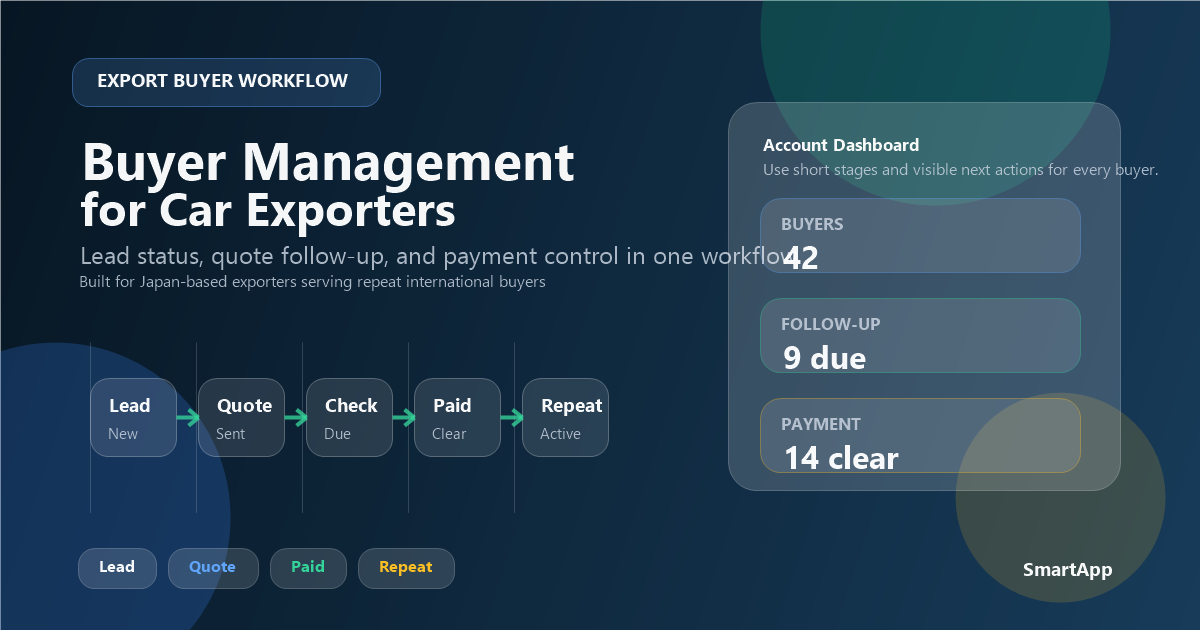
Many Japanese used car exporters think their biggest operational problems start with auctions, shipping, or documents. In reality, buyer management often becomes unstable much earlier and quietly damages all three. A quote is sent without a clear record of the buyer's real budget. A customer asks for three similar units, but the team cannot see what was already offered. Payment expectations are discussed in chat instead of in the order record. Two staff members follow up with the same account differently. A first-time buyer is treated like a repeat account, and a repeat account is treated like a brand-new lead. None of those issues look dramatic on day one, but together they create confusion, weaker conversion, and avoidable payment risk.
That is why car export buyer management is not just a sales question. It is an operational question. The buyer record needs to support vehicle selection, quote timing, payment rules, document handling, shipment visibility, and repeat-order planning. A generic contact list is too shallow. The exporter needs a live account view that reflects how the business actually trades.
This is especially true for exporters selling across Africa, South Asia, the Middle East, and other price-sensitive markets where follow-up speed, trust, and payment discipline all affect whether deals close. If you already understand the broader workflow from our guide to managing a car export business, think of buyer management as the commercial layer that keeps the customer side of that workflow from falling apart.
In short
Strong buyer management gives the exporter one trusted record for who the buyer is, what they want, what they were quoted, how they pay, and what happened after the last shipment. Without that record, sales and operations drift apart.
What the buyer record should actually contain
A useful buyer record is not a phonebook entry. It is the commercial memory of the account. When exporters say they "know the buyer well," that knowledge is often trapped in one salesperson's inbox, WhatsApp history, or memory. That approach collapses as soon as another staff member needs to quote, check payment behavior, answer a document question, or support a shipment already in motion.
The right buyer record needs enough structure to support both sales action and operational action. It should help the team answer practical questions quickly: what kind of units this buyer usually wants, which markets they serve, whether they respond fast, how reliable payment has been, which quote basis they prefer, and whether any special document or shipping requirements apply.
| Field group | What belongs there | Why it matters |
|---|---|---|
| Identity and channel | Company, person, market, phone, email, messaging channel | Prevents duplicate leads and makes follow-up consistent |
| Market profile | Destination country, preferred segments, budget range, trim preferences | Stops the team from quoting stock that was never a real fit |
| Commercial behavior | Response speed, negotiation style, quote basis preference, approval path | Improves quote strategy and account handling |
| Payment behavior | Deposit pattern, balance timing, late-payment history, release conditions | Reduces credit surprises and poor release decisions |
| Operational requirements | Document needs, inspection needs, shipping preferences, buyer portal or update expectations | Prevents sales promises that operations cannot support |
| History and outcomes | Quotes sent, units bought, complaints, no-sale reasons, repeat-order notes | Turns one-off selling into account-based learning |
This is also why car export buyer management is different from a generic sales CRM. The buyer record must connect directly to real units, shipment milestones, and payment checkpoints. If the system knows the buyer but not the actual vehicles, documents, or order status, the team still ends up rebuilding the story manually every time a question comes in.
Lead qualification: exporters need more than interest, they need commercial fit
One of the biggest mistakes in buyer management is treating every inquiry as if it has the same value. Some leads are serious commercial buyers. Others are information collectors, price shoppers without real budget, or early-stage contacts who may convert later but should not distort the current pipeline. Exporters need a qualification method that is clear enough for staff to use consistently and practical enough to improve day-to-day decisions.
The purpose of qualification is not to reject people too quickly. It is to protect time, quotes, and stock from being handled with the wrong priority. A qualified buyer does not need to be perfect. They need to show enough commercial reality that the team can decide how much attention and flexibility the opportunity deserves.
1. Market fit comes before product enthusiasm
A buyer may sound enthusiastic and still be a poor operational fit. The exporter needs to know where the units are going, which types of vehicles actually move in that market, and what landed-price tolerance the buyer works within. If that information is unclear, the quote process becomes expensive guesswork.
This is where buyer qualification overlaps with pricing discipline. If the buyer's market and budget are vague, the exporter will struggle to set a realistic quote basis or source the right stock. That is one reason this article connects naturally with our guide to Japanese used car pricing for export.
2. Payment expectations should be clarified early, not after stock is reserved
Exporters often delay the payment conversation because they want to keep the lead warm. That feels polite and creates risk. The team should know whether the buyer expects deposit-first, partial advance, balance-before-release, open-account behavior, or something more flexible. A buyer who negotiates hard on payment but stays vague about timing should not be handled like a low-risk repeat account.
Clear payment qualification protects the business from assigning valuable stock too early. It also helps operations understand which orders are likely to move smoothly and which ones need stronger milestone control.
3. Communication quality reveals more than many teams realize
Response quality is often a useful signal. Buyers who answer key commercial questions clearly, confirm specifications, react within a predictable time, and understand next steps are easier to serve than leads who repeatedly restart the conversation. This does not mean every slow responder is a bad lead. It means the account should be handled with the right level of caution and expected conversion probability.
A strong buyer-management system therefore stores not only contact details but also communication pattern. That helps managers understand whether pipeline weakness comes from poor lead quality, weak follow-up discipline, or a real market problem.
Quote follow-up should be a workflow, not a memory test
Exporters lose surprising numbers of deals not because the price was wrong, but because follow-up was weak. A quote goes out, the team assumes the buyer will reply if interested, and then the opportunity drifts away. In a busy exporter workflow, quotes compete with auctions, inventory, documents, and shipping issues. If the follow-up process is not structured, sales activity gets pushed behind urgent operations every time.
A better approach is to define a short follow-up cadence by buyer type. First quote sent. Follow-up after a set period. Clarify objections. Refresh with alternate unit if needed. Mark the reason for no sale if the opportunity ends. This is not about annoying buyers. It is about making sure the pipeline tells the truth.
| Stage | Typical action | Why it matters |
|---|---|---|
| Quote sent | Record vehicle, basis, validity, and expected next response date | Prevents quotes from disappearing after the first message |
| Early follow-up | Check whether the buyer saw the quote and understood the offer | Separates silence from real rejection |
| Objection handling | Clarify price, stock fit, payment concerns, or shipping basis | Shows whether the deal is recoverable or fundamentally weak |
| Alternate offer | Propose another unit if the first car missed the buyer's budget or spec | Turns a no-sale into usable market feedback |
| No-sale reason logged | Record price, timing, trust, payment, or spec mismatch | Creates better sourcing and quoting decisions later |
This is one of the clearest places where buyer management supports the wider operation. If the team cannot see which quotes are still alive, stock can be held too long, pricing may not be refreshed, and buyer updates become inconsistent. A serious exporter does not leave those decisions to memory alone.
Payment control is part of buyer management, not a separate finance issue
Many exporters separate sales from payment discipline in their thinking. Sales gets the order. Finance handles the money. Operations handles the shipment. In practice, those layers are tightly connected. A buyer with unclear payment behavior changes how the exporter should quote, reserve stock, release documents, and stage shipment. If buyer management does not include payment logic, the business takes credit risk without seeing it clearly enough.
The strongest exporter workflows therefore tie buyer records directly to payment milestones: quote basis, proforma status, deposit received, balance due, balance confirmed, documents released, shipment dispatched. That structure matters because it keeps release logic visible instead of negotiable by message thread.
Practical Rule
A new buyer record should never look complete without a clear payment rule attached to it.
That rule can differ by buyer type, market, or trade relationship, but it should exist before the order reaches the release stage.
New buyers need tighter milestones
For a first order, exporters usually need stronger control over proforma, deposit, and document release timing. The purpose is not distrust for its own sake. It is risk clarity. First orders are where assumptions about seriousness and payment discipline get tested.
Repeat buyers can be faster, but not unmanaged
A reliable account may justify smoother handling, but repeat status should be based on evidence: payment behavior, response speed, claim history, and order consistency. Repeat buyers still need checkpoints. They simply may not need the same friction as a new account.
Document and shipment release should follow verified milestones
This is where buyer management crosses into execution. If the payment status is vague, the team should not pretend the order is operationally clean. The buyer record, order file, and shipment status all need to reflect the same truth.
Repeat buyers deserve account management, not perpetual first-order treatment
The most profitable exporters rarely depend only on one-off transactions. They build repeat relationships. That does not happen by accident. It happens when the business captures what each strong buyer repeatedly wants and makes the next order easier to execute than the first one.
A repeat buyer account should therefore hold more than contact details. It should show preferred segments, price tolerance, usual shipment pattern, documentation preferences, payment rhythm, and the issues that mattered last time. When that record exists, the exporter can source more intelligently and respond faster. When it does not, every order starts from zero and staff waste time relearning the same account.
| Buyer tier | Typical characteristics | How to manage them |
|---|---|---|
| New lead | Limited history, uncertain seriousness, payment behavior unknown | Qualify carefully and use tighter commercial controls |
| Active developing buyer | Some quote history, occasional purchases, still learning each other's workflow | Track objections, preferred units, and payment patterns closely |
| Repeat account | Clear preferences, stronger trust, known document and payment behavior | Use faster sourcing and cleaner account-based follow-up |
| High-risk account | Late-payment signals, unclear communication, repeated order friction | Escalate controls and do not let relationship language hide risk |
This tiering also improves management visibility. Leaders can see whether growth is coming from healthier repeat business or from a constantly rebuilt pipeline of uncertain leads. That distinction matters because one scales more safely than the other.
Sales-to-operations handoffs are where weak buyer management becomes expensive
A buyer file that looks fine to sales can still be almost useless to operations. The customer may be marked as confirmed, but the shipping basis is unclear. The unit is reserved, but the payment milestone is not. The buyer expects a specific document sequence, but the documentation team never saw that note. A shipment update is requested, but the buyer-facing contact method is missing. These issues are all handoff failures, and they often start because buyer management is treated as a front-end activity rather than as a live export workflow.
The better model is to make the buyer record operationally visible. Once an order becomes active, operations should see the same buyer context that sales sees, but filtered to what matters operationally: contact route, promised basis, payment state, document needs, and any special delivery or update requirement. That is what turns a CRM-style record into a genuine export account record.
This is one reason SmartApp's value is not only in storing data. The deeper value is connecting the buyer side of the business to inventory, shipment, and document status so each team works from the same truth. If your export operation still separates those records, the buyer experience will eventually reflect that fragmentation.
A simple handoff checklist
The KPIs that make buyer management visible instead of anecdotal
Buyer management gets better when the team measures what actually affects growth and risk. Sales volume alone is not enough. The business needs to know whether quotes convert, which accounts repeat, how often payment drifts, and whether communication speed is improving or only feeling busy.
| Metric | Why it matters | Management question behind it |
|---|---|---|
| Quote-to-order conversion | Shows whether quotes are landing on real buyers and real needs | Are we quoting well, or are we quoting too broadly? |
| Repeat-order rate | Reveals whether the business is building accounts or just chasing fresh leads | How much of our growth is relationship-driven? |
| Average response time | Measures commercial discipline, not just activity | How quickly do serious buyers get useful answers? |
| Late-payment frequency | Shows where commercial risk is being normalized | Which accounts are weakening release confidence? |
| No-sale reason mix | Turns lost deals into sourcing and pricing insight | Are we missing on price, stock fit, payment terms, or follow-up quality? |
| Buyer profitability by account | Prevents revenue from hiding weak commercial value | Which buyers are truly worth faster service or special handling? |
These metrics are most useful when they sit beside inventory, shipment, and payment data. If the sales dashboard lives separately from the operating reality, management still cannot see the full picture. That is another reason exporters often graduate from generic CRM tools to a more connected exporter workflow platform.
The buyer-management mistakes exporters repeat again and again
Treating every lead like a qualified buyer
That wastes quotes, staff time, and sometimes stock allocation. Qualification is not about being rigid. It is about using attention where commercial fit is real.
Letting buyer history live in personal chat threads
Once the knowledge sits in one person's phone, the company cannot scale the account or hand it off cleanly.
Separating payment behavior from the buyer record
That makes risk feel smaller than it is. Payment history should shape account handling, not be rediscovered after a delay.
Failing to record why quotes do not convert
Without a no-sale reason, the pipeline looks active but teaches the business very little about sourcing, pricing, or follow-up quality.
Managing repeat buyers as if every order were new
That slows growth and wastes the commercial memory the business should already own.
Why a generic CRM is usually too shallow for exporter buyer management
Generic CRM tools are designed to manage leads, contacts, and sales opportunities in a broad sense. That is useful, but exporters need more. They need buyer records that stay connected to actual vehicles, quote bases, document milestones, shipment updates, and payment checkpoints. If those layers live outside the CRM, teams still have to rebuild the order story every time a buyer asks a question or management reviews an account.
That is why the best car export buyer management setup is usually part of a wider exporter operating system rather than a stand-alone contact database. Buyer updates should reflect real stock and shipment status. Payment fields should link to release logic. Account notes should feed sourcing and pricing. Repeat-order patterns should inform how the next quote is prepared. A generic CRM can store the contact, but it often does not understand the exporter workflow around the contact.
This is also where automation matters. If quote follow-up, buyer-status updates, and shipment notifications still depend on manual reminder discipline, growth slows. That is why a buyer-management article naturally points back to both car export management software and export workflow automation. The goal is not CRM language. The goal is cleaner exporter execution.
What strong buyer management software should show
External reference points exporters should keep in view
Buyer management sits inside broader trade reality, so exporters should stay aware of sources that help validate market and trade assumptions. Useful references include JETRO for market and trade context, the International Chamber of Commerce for trade-term context around quote basis, and UNCTAD trade logistics resources for the wider shipping environment that often shapes buyer expectations.
Those sources will not tell you which buyer deserves a faster follow-up, but they do help keep your commercial workflow aligned with the trade environment your customers are buying into.
Buyer management FAQs
What should exporters store in a buyer management system?
Exporters should store buyer identity details, country and market focus, preferred vehicle types, quote history, payment behavior, document requirements, communication notes, and the status of active orders or follow-up tasks. If that information is scattered, the account will never become truly manageable.
Why is buyer management different from a generic CRM?
Because a car export business needs buyer records tied directly to vehicle stock, shipping milestones, payment checkpoints, and export documents. A generic CRM may track the contact and the deal stage, but it often misses the operational layers exporters depend on.
How do exporters reduce payment risk with new buyers?
They qualify the buyer before committing stock, make quote basis and payment rules explicit, confirm commercial terms early, and tie release steps to verified payment milestones instead of loose verbal commitments.
How often should buyer records be updated?
After every meaningful interaction: new lead intake, quote sent, order confirmed, payment received, shipment dispatched, complaint handled, or repeat-order discussion. A buyer file that updates only sometimes becomes unreliable very quickly.
What KPI matters most in export buyer management?
No single KPI is enough on its own. The strongest set usually includes quote-to-order conversion, repeat-order rate, payment delay frequency, average response time, and buyer profitability by market or account type.
Author and experience context
Reviewed by SmartApp Export Operations Team
This article was prepared from the perspective of exporters that need the customer side of the workflow to stay as structured as auctions, stock, shipping, and documents. SmartApp works around exporter processes where buyer status, vehicle status, and payment status cannot be allowed to drift apart. That is why the recommendations here focus on visibility, handoff quality, and account discipline rather than generic CRM theory.
The core principle is simple: if the company cannot see what the buyer was promised and what the buyer has actually done, the workflow is weaker than it looks.
Supporting guides for this topic cluster
Japanese Used Car Pricing for Export
Use pricing discipline to support quotes that buyers can actually close.
Export Documents from Japan
Keep buyer communication aligned with the paperwork required to complete the deal.
Stockyard Management for Exporters
Make buyer updates credible by keeping stock and readiness visible.
Conclusion
Car export buyer management improves when exporters stop treating customers as separate from the workflow and start treating them as part of the workflow. A clean buyer record, a visible quote history, a real follow-up cadence, and clear payment checkpoints make the business easier to scale because sales, operations, and finance stop working from different versions of the same account.
If your current customer management still lives in phones, chat threads, and spreadsheet tabs, that is probably already creating friction you can feel but cannot yet measure. A more connected buyer workflow usually fixes that faster than teams expect.
See how SmartApp helps exporters connect buyer records, inventory, shipment progress, and payment status in one operating system.
Book a Demo